Anyone planning a lift eventually runs into this question, and the two terms get confused often enough that it is worth answering properly. A mobile crane and a hydraulic crane are not competing options in the way the question implies. One describes how the crane gets to your site. The other describes how it lifts once it is there. Understanding the difference is the first step to figuring out what your West Michigan job actually needs.
What Is a Mobile Crane?
A mobile crane is defined by how it travels and sets up, not by how it lifts. It is mounted on wheels, either a truck chassis or an all-terrain undercarriage, and it drives to the job site under its own power. Once there, it sets up on outriggers, extended legs that stabilize the crane and distribute its weight across a wider footprint, and it is typically ready to lift within an hour of arrival.
This is the key advantage a mobile crane offers: speed of mobilization. Compare that to a tower crane, which arrives disassembled on trucks and requires a separate assembly crew working over several days before it can lift anything at all. A tower crane only makes sense when a job needs a crane fixed in one place for months at a time, such as a high-rise build. For nearly every other job, including the vast majority of construction, industrial, and residential work in West Michigan, a mobile crane’s ability to show up, set up, and start lifting the same day is what makes it the practical choice.
Mobile cranes come in a wide range of sizes and capacities, from compact units suited to tight residential lots up to large machines with long booms for tall, heavy industrial and commercial work. What they share is the mobility itself: they are equipment that travels to you, rather than equipment assembled in place.
What Is a Hydraulic Crane?
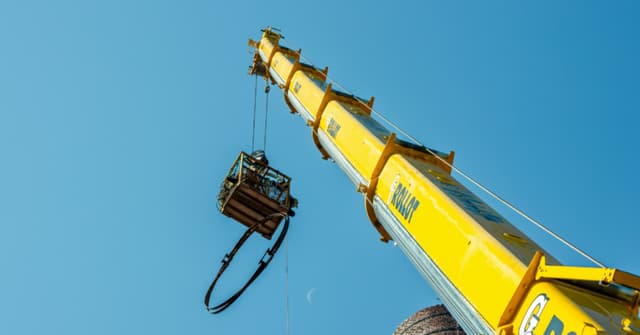
A hydraulic crane is defined by how its boom moves, not by how it gets to the site. It uses hydraulic cylinders, fluid-powered pistons, to extend, retract, and raise or lower the boom. This gives the operator smooth, precise, continuously variable control over the boom’s reach and angle, rather than fixed increments.
This matters directly during a lift. Hydraulic control lets an operator make small, exact adjustments to position a load precisely, whether that is setting a beam onto a bolt pattern with little tolerance for error or lowering a rooftop HVAC unit onto a specific curb. It is the dominant boom technology in the crane industry today because of this precision, and it applies across a wide range of crane sizes and configurations.
The American Society of Mechanical Engineers publishes the B30 series of standards covering the design, inspection, and safe operation of this kind of lifting equipment, and hydraulic boom systems are addressed within that framework regardless of whether the crane underneath them is mobile or fixed in place.
Why Most Cranes Doing Everyday Lifting Are Both at Once
Here is the part that resolves the confusion: mobility and hydraulic boom control are two separate features, not two separate categories, and most cranes working construction, industrial, and residential job sites today combine both. A mobile hydraulic crane drives to your site under its own power and uses hydraulic cylinders to extend and control the boom once it gets there. When people ask whether they need “a mobile crane or a hydraulic crane,” the honest answer is usually that they need a mobile hydraulic crane, and the real decision is about size and configuration, not category.
So How Do You Decide What You Actually Need?
Since category is rarely the deciding factor, the real decision comes down to three things measured against a specific crane’s load chart: how much the load weighs, how far it has to travel from where the crane can set up, and how high it has to go. A crane’s usable capacity drops as the load moves farther out and higher up, which means a machine rated for 150 tons at a short radius may only handle a small fraction of that at full extension. Matching those numbers to the right crane, not just picking the biggest one available, is what actually determines whether a lift goes smoothly.
Ground conditions and site access factor in just as heavily. A crane’s rated capacity assumes stable, level ground under the outriggers, and soft ground, slopes, or unknown subsurface conditions all reduce what it can safely lift. On tighter West Michigan sites, older residential neighborhoods, downtown commercial lots, properties with narrow driveways or overhead lines, access constraints often matter more than raw capacity, since a larger crane that cannot get close enough to the load is no better than one that is undersized.
What to Tell a Crane Company Before They Quote the Job
- The weight of the load, or your best estimate
- The distance from where a crane could set up to where the load needs to go
- The height the load needs to travel, including anything it needs to clear
- Site access details: driveway width, overhead lines, ground surface, and nearby obstructions
With those details, matching the right crane to the job is straightforward. This is exactly the calculation a crane operator certified through the National Commission for the Certification of Crane Operators is trained to make, working from OSHA’s cranes and derricks standard and the load chart for the specific equipment being used.
The Bottom Line
Mobile describes how a crane gets to your site. Hydraulic describes how it lifts once it is there. Most working cranes are both, so the real question for your job is not which category to choose but which specific size and configuration fits your load, your reach, and your site.
Cornerstone Crane Service operates a fleet ranging from 26 tons up to 150 tons with a 124-foot main boom, and every job starts with a conversation about the load and the site. Call us to talk through your next lift.